Improve organic search rankings through technical SEO

by Steven Blackman
Published: December 2023
work-gallery
Plant the seeds for increasing organic search traffic by improving your website’s technical SEO.

Technically optimising your website is essential for reaping the maximum benefit from organic search. If your website isn’t visible through search engines or is hard to navigate, then it doesn’t matter how good your content is; few will see it, let alone read it.

There are a number of boxes to be ticked when improving technical search engine optimisation (SEO). Take a look through the points below and ask yourself how your website scores on these criteria.
Mobile optimisation

According to Statista, mobile internet traffic as a share of global online traffic, reached 58.5% in January 2023. With the trend pointing upwards, Google prioritises mobile-first indexing. This means a responsive website serving content for the small screen is a must, not only to reach the five billion or so mobile internet users worldwide, but also to score higher in search results.

Enable HTTPS

HTTPS (Hypertext Transfer Protocol Secure), the successor to HTTP, securely sends data from a web browser to a website. SSL/TLS security protocols facilitate this transfer. Critically, an SSL certificate is required for an HTTPS web address. These are available through a certificate authority and are often handled by hosting companies on the website owner’s behalf.

An SSL certificate is required for an HTTPS web address.

Page speed

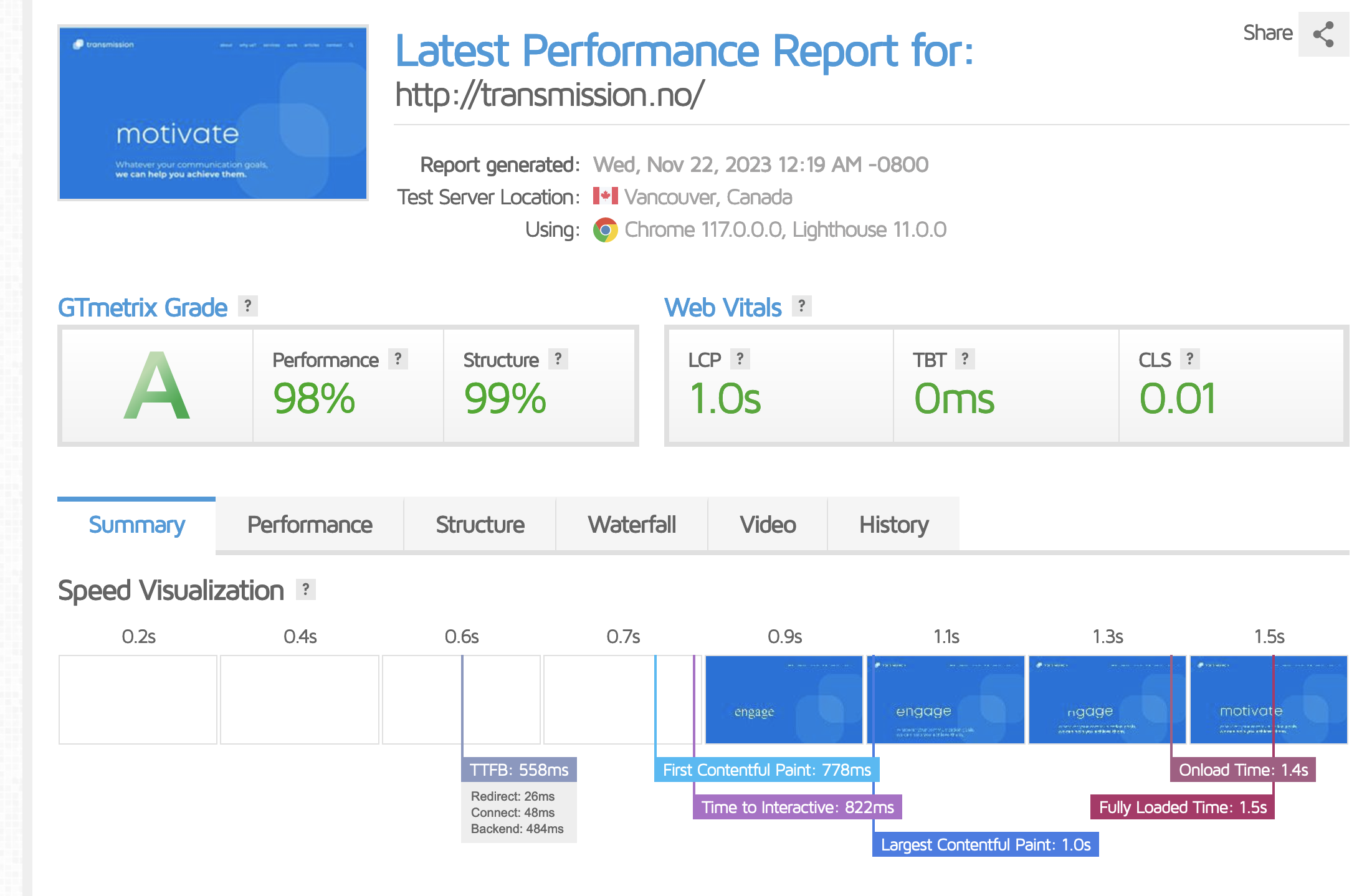
How many of us have grown impatient waiting for a website to load? Well, it is the same for Google. It gets fed up as well and scores the website accordingly. There are a number of free resources that provide reports on your website’s performance for both desktop and mobile. Three of the more popular ones are GTMetrix, Pingdom and Google’s WebPage Insights. Look at the reports generated and consider the suggestions for improvement.

One issue that often crops up is image optimisation, due to heavy files that load slowly. Picture files should be lightweight, but of a high-enough quality to provide image clarity.

Improve organic search rankings through technical SEO
GTMetrix.com (22.11.23)
Gain insights into website performance by using performance and monitoring tools. The example shows the overall performance on GTMetrix score for transmission.no.

Crawlability and indexability

Search engines’ ability to find a website or web page (crawlability) and the ease of adding that site or page to its index (indexability) are cornerstones of technical SEO. Without both, your content doesn’t get off the starting line. Here are a few suggestions to improve both crawlability and indexability:

  • Add an XML sitemap, which outlines website structure and shows page URLs, to your site and submit it to Google through its search console.
  • Limit page redirects: An over-reliance on redirect coding may slow page-load times, so use this sparingly. Ensure the correct redirect is used (301 for permanent, 302 for temporary), and avoid chain redirects altogether, i.e. a redirect of a redirect.
  • Improve image accessibility and context with descriptive file names and alt text.
  • Check for and fix ‘404’ page-not-found errors. If a website consistently returns 404s, it tells search engines that the website is poorly maintained and offers a substandard user experience, which directly impacts search engine rankings. Google Search Console can be a handy aid in identifying such pages.
  • Include keywords in your URLs, and keep them simple, consistent, descriptive and accurate. Use lower case and avoid ‘stop’ words such as ‘the’ and ‘of’.
  • Optimise canonicalisation (see below).
  • Use structured data markup, also called schema markup, to give search engines additional content information.
  • For large, multi-level sites, implement breadcrumb navigation, which are link trails often placed at the top of pages. These help both users and search engines navigate content.
eBay.com
For larger and more complex sites, breadcrumbs offer an alternative way to quickly reference earlier pages.

Canonicalisation

According to Google, canonicalisation is:

“…the process of selecting the representative – canonical – URL of a piece of content. Consequently, a canonical URL is the URL of a page that Google chose as the most representative from a set of duplicate pages.”

This only comes into effect if your site has duplicate content. If you have two web pages that are the same or very similar, then Google aims to serve only one in the search results. An example is same-language product pages provided under country-specific URLs, where only the price changes. If you do not specify the preferred page version, then Google will make the choice for you.

Create solid foundations for technical SEO

By paying attention to technical SEO, you create a solid foundation for better search engine visibility and user experience. Regularly monitor, analyse and update your site to ensure it remains optimised for both search engines and users alike. For assistance with website design, development and maintenance, please get in touch.